Egon Schiele’s “Four Trees”: A Psychological Landscape
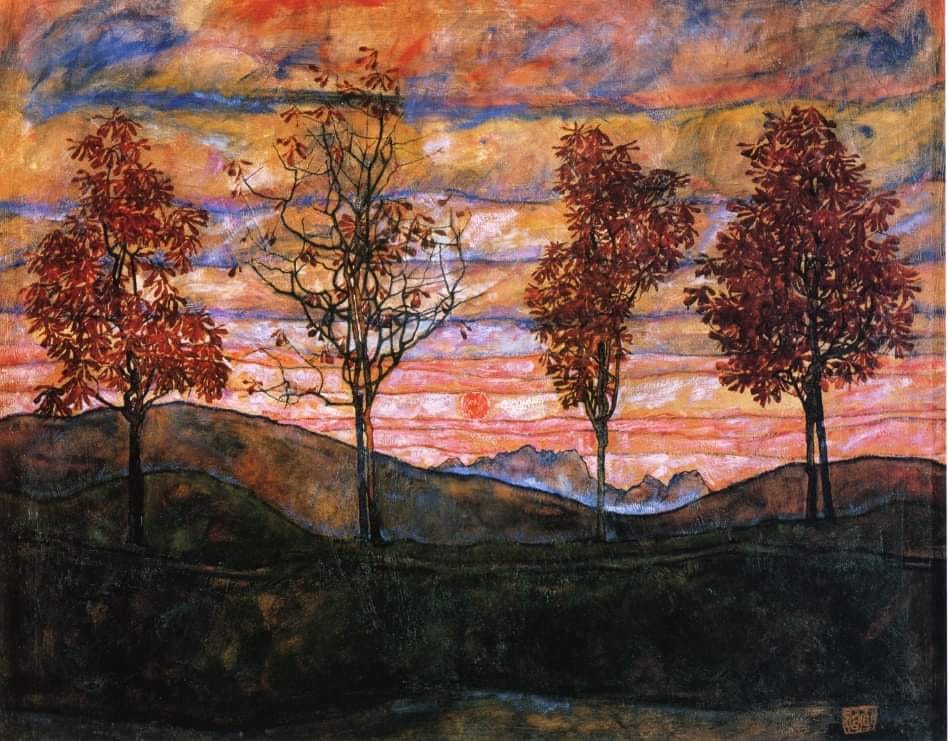
Egon Schiele’s “Four Trees” (1917) stands as one of the Austrian expressionist’s most profound analyses of human psychology as seen through the natural world. While known primarily for his searing portraits, this landscape uses stark lines and contrasting colors to explore not only the forms of trees but also the complex terrain of the human spirit. Schiele’s striking composition presents the raw reality of nature while provoking deep contemplation. Each of the four trees conveys a distinct atmosphere, highlighting the painter’s existential reflections and his connection to the natural world.
While landscapes are less central to Schiele’s oeuvre than his figural work, they are profoundly revealing. “Four Trees” is a painting of rare beauty, where the trees are rendered in his characteristic style: tall, thin, and almost human-like. This is an introspective approach in which Schiele finds reflections of nature in humanity and vice-versa. The branches, trunks, and leaves are depicted as symbols of the human body’s movements and emotions. This fusion allows the viewer to experience the spiritual depths of nature and the inner world of man simultaneously. The dramatic lighting, which strikes each tree from a different direction, enhances its unique character and narrative.
The trees are placed near the center of the canvas, yet each is twisted into a unique form, creating a sense of dynamic movement as if they are dancing with the wind. These distinct postures capture the viewer’s attention and reflect the powerful, ever-changing structure of nature. The play of light and shadow between the branches adds significant depth to the composition, allowing one to feel the motion within the scene more intensely.
Schiele’s use of color is vivid and contrasting. In “Four Trees,” exaggerated color differences between the trees and the background create a powerful emotional effect. Intense blacks, reds, yellows, and blues express both the vitality and the darkness of nature—and by extension, of the human condition. These colors function psychologically: red and yellow can evoke passion and energy, while blue and black suggest melancholy and death. This deliberate use of color, which follows a path from Giotto to Van Gogh and the Expressionists, grants the work a profound psychological resonance.
Schiele’s brushstrokes are often shaky and rapid, giving his paintings an improvised quality and a raw energy. In “Four Trees,” these “unconscious” lines appear in the branches and trunks, depicting the inner life and movement of the trees. These striking marks suggest that the trees are not static objects but living, emotional beings in a constant state of flux. Rather than focusing on realistic detail, Schiele uses linear expressions and blocks of color to capture the essence of his subjects. Like characters in a novel, each tree tells its own story.
In this work, Schiele establishes a metaphysical connection between nature and humanity. By depicting trees as extensions of the human form, he invites the viewer into introspection and fosters empathy for the natural world. The painting’s somber atmosphere, with its melancholic, sunset tones, prepares the viewer for an unexpected crescendo hidden within the stillness, reminiscent of the unease in a Mahler symphony.
Schiele’s work often reflects existential anxieties and the unresolved complexities of the human soul—themes of introspection and melancholy that were part of the era’s general atmosphere. In this sense, “Four Trees” alludes to the transience of life, the inevitability of solitude, and the overwhelming power of nature. Through this landscape, Schiele opens a dialogue with the viewer about life, death, and human destiny.
In conclusion, “Four Trees” is a clear example of Schiele’s artistic journey. The work is more than a depiction of four trees; it is an expression of an era’s mood and a testament to the artist’s own evolving vision. By exploring emotional and psychological depths in a landscape, Schiele proved that his expressive power extended far beyond the human figure. He invites us not just to think about, but to feel the intricate connection between the natural world and the human soul—a testament to the universal power of his art.
● ONUR AYDEMİR ●
● 2025, ANKARA ●


